South Atlantic and White Sand Shallows
A lagoon sheltered by the coral reef, shallow sandbanks where you can swim 3 km from shore, and a dozen islets between François and Vauclin.
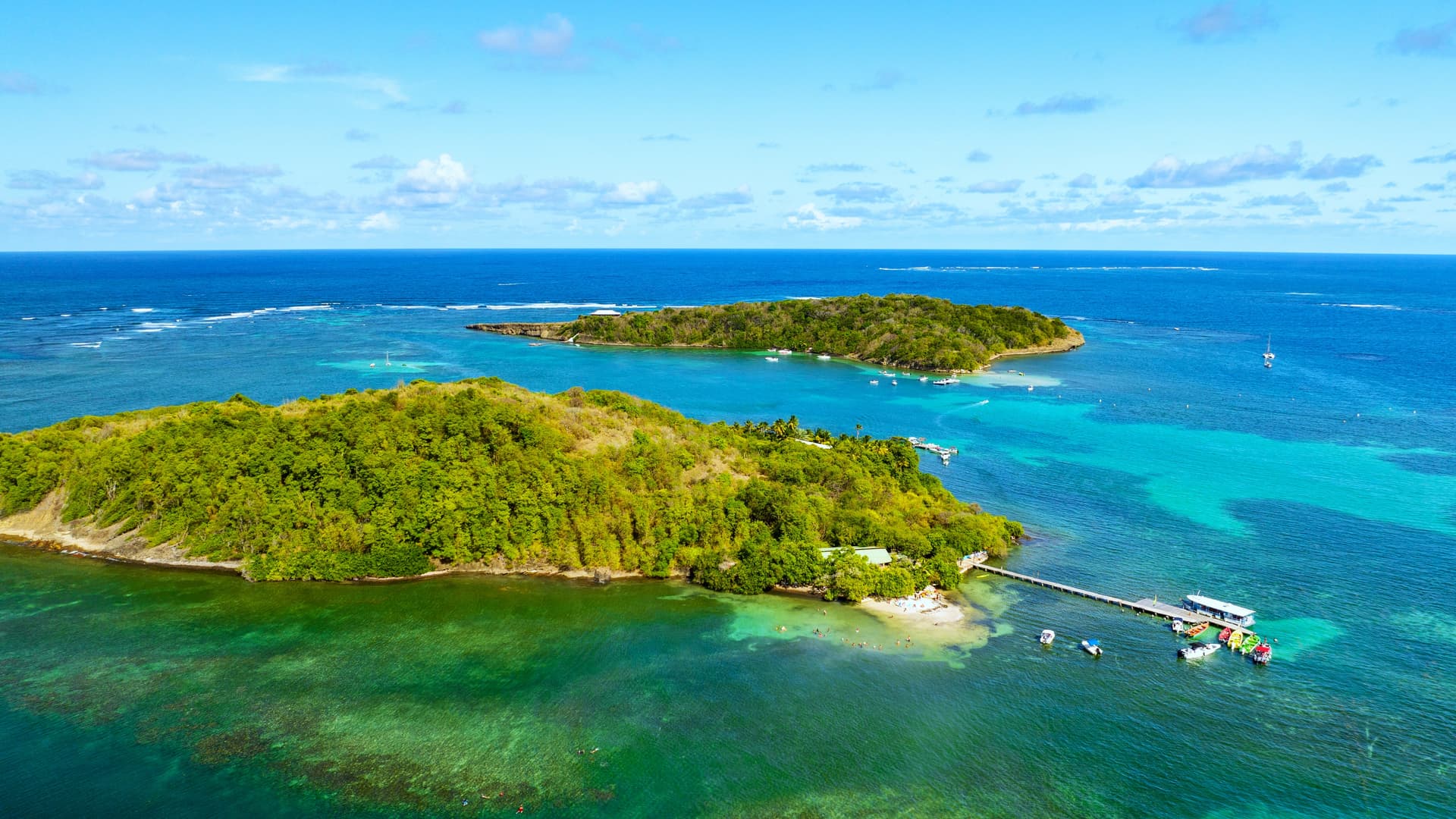
The Atlantic coast of southern Martinique stretches from François to Vauclin, then extends toward Sainte-Anne through a succession of bays, mangroves, and islets. It has a particular geography: the coral reef, located 2 or 3 km offshore, breaks the Atlantic swell and creates a shallow interior lagoon. In certain areas, coralline sand forms white sand shallows where water barely exceeds one meter, in open sea. These shallows are reached by yole or motorboat from the docks of François, Vauclin, or Robert slightly further north.
François concentrates the nautical activity of the coast. The town retains its small agricultural city atmosphere with its Saturday morning market, neighboring distilleries (Clément at Acajou, Habitation Saint-Étienne further inland), and its anchorage dotted with a dozen islets. Three stand out: Îlet Oscar, a private property turned into a colonial guesthouse, Îlet Thierry, more rustic, and Îlet Chancel, the largest, which still shelters a population of Lesser Antilles iguanas, an endemic species in decline elsewhere on the island. Joséphine's Bathtub, the most famous shallow, owes its name to the tradition that the empress once bathed there. Today, it is the classic stop on days at sea, with ti-punch served on deck and disembarking into waist-deep water.
Further south, Vauclin and Marin organize Martinique's yachting scene. Marin hosts the largest marina in the Caribbean, around 800 berths, and concentrates most catamaran rental bases. This is where itineraries depart toward Saint Lucia, the Grenadines, or Dominica. The village of Vauclin remains focused on coastal fishing and preserves a traditional Creole settlement layout, centered on its church and fish market. Pointe Faula, just north of town, offers one of the island's most frequented kitesurfing and windsurfing spots thanks to consistent trade winds blowing between 15 and 25 knots for much of the year.
The interior deserves time. The hills of Vauclin peak at 504 meters and offer panoramas across the entire east coast. The lands between François and Robert remain agricultural: sugarcane fields, banana plantations, brahman cattle ranches. The distilleries in the area, led by Clément, have preserved their 19th-century plantation buildings, transformed into visitor tours with tastings. AOC Martinique agricultural rum is crafted here from fresh cane juice, which distinguishes local production from that of the Grenadines or Guadeloupe.
On the dining side, the south Atlantic coast cooks what the sea brings: white sea urchins (chadrons) in regulated season, conch, spiny lobsters, red snappers caught in traps. Waterfront restaurants around Cap Chevalier, in Sainte-Anne, or on the Vauclin peninsula serve accras, Creole blood sausage, fish colombo, and the classic grilled fish with dog sauce. Several operators offer full-day yole outings combining white sand shallows, mangrove, and lunch on a private islet—a formula that remains the best way to understand this fragmented geography.
The region stands in stark contrast to the neighboring beach-lined South: here, no long stretches of white sand like at Les Salines, but rather a jagged coastline, islets, and a lagoon. The traveler seeking calm swimming, water sports, and undeveloped shoreline will find what they're looking for. Those who want to alternate lazy days on fine sand with outings at sea will shuttle between the far South, a 40-minute drive away.
To Discover
Day trip by yole to the white sand shallows. Departure from the François dock for a 6-hour loop: Joséphine's Bathtub, Îlet Oscar, lunch on Îlet Thierry, and passage through Robert's mangrove. Water at waist height in the middle of the ocean, ti-punch and accras served on board.
Iguanas of Îlet Chancel. A half-day to observe the Lesser Antilles iguana in its last Martinique sanctuary. The islet also preserves ruins of the island's first pottery, dating from the 17th century.
Kitesurfing at Pointe Faula. Vauclin offers a shallow anchorage protected by the reef, with steady trade winds of 15 to 25 knots between December and June. Several schools offer lessons and rentals.
Clément Distillery at Acajou. The 19th-century plantation at François can be visited with its botanical park, aging cellars, and period-furnished main house. Tasting of aged AOC Martinique rums at the end of the tour.
Cap Chevalier and Îlet Chevalier. At the southeastern tip, a small beach and an islet accessible on foot at low tide across 200 meters of shallow water. Fishermen's restaurants serving the catch of the day facing the open sea.
When to Visit
The south Atlantic coast welcomes visitors year-round, with a clear preference for the dry season, Lent, from December to April. Water temperatures hover around 27°C, air between 25 and 30°C, and trade winds blow steadily between 15 and 25 knots, which cools days and benefits water activities. Rains are brief, often morning showers, and underwater visibility reaches its peak (15 to 20 meters) between February and April.
From June to November, the rainy season brings heavier showers, particularly in September and October when monthly totals can exceed 250 mm. Swell remains broken by the coral reef, so yole outings continue, but cyclone risk demands vigilance between August and October. May and June are a good intermediate window: fewer crowds, clear water, flexible rates. We avoid, however, the last two weeks of July and the first week of August, metropolitan holiday periods when the islets and shallows become crowded.
Practical Advice
Plan 2 to 3 days on-site to enjoy without rushing: a full day for a white sand shallows and islets outing (roughly 6 to 7 hours at sea), a half-day for a distillery and the town of François, a day for Vauclin, Pointe Faula, and Cap Chevalier. The region is accessible in 45 minutes' drive from Aimé-Césaire Airport in Lamentin, and 30 minutes from Fort-de-France. The entire coast is traversable by the N6 then D7 roads, with a rental car essential.
The most natural combination pairs with the beach-lined South (Sainte-Anne, Les Salines, Le Diamant) to alternate sand beaches and sea outings, the whole forming a coherent stay of 5 to 7 days. Downtown Fort-de-France rounds out well for a day of urban and cultural exploration. For a 10-day trip, we add the Caribbean North and the Caravelle peninsula to contrast with volcanic landscapes and wild coastline. Lodging ranges from family guesthouses to villas with private docks, including a few charming hotels on the islets. The region suits families, sailors, and contemplative travelers who prefer a day at sea to group excursions. Hikers will find more elevation in the island's north.