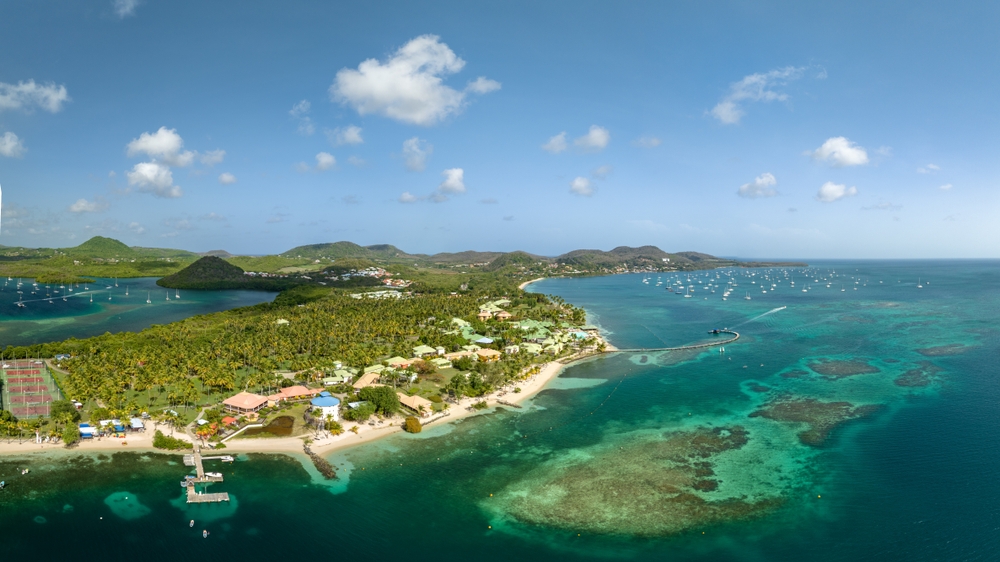
Marie-Galante
Marie-Galante, a round island 30 km from Pointe-à-Pitre, combines secluded beaches, AOC agricultural rum produced in three artisanal distilleries and a sugar heritage visible through its windmills.
Marie-Galante is a round island in Guadeloupe, nicknamed "la Grande Galette" for its nearly perfect circular shape. Located roughly thirty kilometers south of Pointe-à-Pitre, it encompasses three municipalities — Grand-Bourg, Capesterre-de-Marie-Galante and Saint-Louis — and cultivates a distinctive identity: renowned agricultural rum, secluded beaches, ruined windmills and vibrant Creole traditions.
Practical Information at a Glance
- Access: ferry from Pointe-à-Pitre (Saint-François or Trois-Rivières depending on the operator); crossing time approximately 45 minutes to 1 hour 15 minutes depending on departure point.
- Recommended duration: 2 to 3 days to combine beaches, distilleries and inland areas.
- Getting around the island: car or scooter rental recommended; limited bus network.
- Dress code: no particular constraints; bring closed shoes for hiking trails.
What to See
The island divides between a coastline of white sand beaches — Capesterre, Petite-Anse, Saint-Louis — and an interior plateau planted with sugar cane. Eighteenth-century windmills dot the landscape; some are partially restored. Three artisanal distilleries produce recognized AOC agricultural rum. The cliffs of Gueule Grand Gouffre, in the north, offer a striking geological spectacle.
History and Context
Christopher Columbus reached the island in 1493 and named it after his flagship. Colonized by France in the seventeenth century, Marie-Galante became a prosperous sugar colony: at its height, it boasted over a hundred windmills. The abolition of slavery in 1848 and competition from beet sugar profoundly transformed the economy, leaving behind an industrial heritage partly visible today.
Highlights of the Visit
Agricultural Rum Distilleries
Three distilleries remain in operation: Bielle, Capesterre and Poisson (Père Labat). Each offers cellar tours and tastings. Marie-Galante's agricultural rum carries AOC Guadeloupe designation. The distillation season, from February to June, is the liveliest period.
Capesterre Beach
A long stretch of white sand fringed with coconut palms, Capesterre is the island's most extensive beach. Shallow waters make it ideal for family swimming. Crowds remain moderate compared to Grande-Terre beaches.
The Windmills
Around sixty windmills survive, including the Moulin de Bézard, partially restored and accessible. They bear witness to eighteenth-century sugar economy. Some are freely visitable, others stand on private property.
Gueule Grand Gouffre
On the north coast, Atlantic waves surge into a natural fissure in the limestone cliff, creating a spectacular effect. Access is on foot via a marked path; caution is advised during rough seas.
Trou à Diable
An underground cave network accessible from Capesterre-de-Marie-Galante. The galleries shelter stalactites and an underground river. Guided tours are mandatory to access the deeper sections.
Photography Tips
Golden morning light is ideal for photographing windmills against sugar cane fields. Petite-Anse beach, facing west, lends itself to sunset shots. For Gueule Grand Gouffre, favor mid-day when light penetrates the fissure. Distilleries generally allow photography in the cellars, but check on-site.
Location and Access
Marie-Galante sits approximately 30 km south of Pointe-à-Pitre. Ferries depart from Bergevin port in Pointe-à-Pitre, Saint-François and Trois-Rivières depending on operators. Grand-Bourg is the main municipality and primary maritime arrival point. The island is largely flat, facilitating travel by bicycle or scooter. Accessibility for visitors with reduced mobility remains limited on natural trails, though main beaches are accessible by car.
Nearby Attractions
- Pointe-à-Pitre — primary embarkation port, commercial town with its covered market and the ACTe memorial.
- Les Saintes (Terre-de-Haut) — neighboring archipelago, accessible by ferry, known for its forts and turquoise waters.
- Saint-François — Grande-Terre municipality with ferry departure to Marie-Galante, marina and beaches.
- La Désirade — remote island east of Grande-Terre, unspoiled nature and low tourist traffic.
Frequently asked questions
The dry season, from December to April, offers the best weather conditions. The rum distillation period, from February to June, is ideal for visiting active distilleries.
Car or scooter rental is the most practical solution. A bus network exists but remains limited in frequency. Bicycles work on flat terrain, though distances between sites can be significant.
A day excursion is possible, but two to three days allow you to cover beaches, distilleries and natural sites without rushing.
The sections open to the public are manageable for most able-bodied visitors. The deeper zones require a guided tour; they are not recommended for people with reduced mobility or claustrophobia.
Yes. It is an agricultural rum produced from fresh sugar cane juice, under AOC Guadeloupe designation. Each distillery has its own aromatic profile; comparative tasting between Bielle, Capesterre and Père Labat is worthwhile.
Marie-Galante offers hotels, guesthouses and seasonal rentals, primarily in Grand-Bourg, Saint-Louis and Capesterre. Supply is more limited than in Grande-Terre; advance booking during high season is advised.
Want to discover this destination?
Our local advisors design your tailor-made trip.